The Year 2013 started well with several activities such as peer counseling trainings, Sanitary towels project where sanitary towels were distributed to some schools and organizations. Schools who benefited on the distribution of sanitary towels were Manyatta primary school and Kosawo primary school and Rawa CDC.
Peer counseling trainings were done in several schools like Maseno school, Lwak Girls High school, Nyawara Girls, Homa Bay Boys, Ogande gGirls just to mention a few.
25 September 2013


14 February 2011
PEER COUNSELLING TO SCHOOLS, 28th Jan -12th FEB. 2011
Maseno school was our first stop in this season's trainings. Established over a century ago, the school prides itself in having produced great leaders, some of whom have occupied high positions like the first Vice-President of the Republic of Kenya, the late Jaramogi Oginga Odinga, and several others who have played notable roles in this country.
The four trainers spent three days at Maseno school, training 51 prefects and senior boys on leadership and other life skills that was aimed at empowering them to be leaders and helpers. In their new roles, these boys can now help the school administration in its task to maintain and improve the school as a center of academic excellence. The training took place from the 28th to 30th January 2011.
On the 3rd to 5th of February the team moved to Sagam Mixed Secondary School, followed by Usenge High School and Sawagongo Secondary School on 10th to 12th of March. The objective of the later three trainings were:
The four trainers spent three days at Maseno school, training 51 prefects and senior boys on leadership and other life skills that was aimed at empowering them to be leaders and helpers. In their new roles, these boys can now help the school administration in its task to maintain and improve the school as a center of academic excellence. The training took place from the 28th to 30th January 2011.
On the 3rd to 5th of February the team moved to Sagam Mixed Secondary School, followed by Usenge High School and Sawagongo Secondary School on 10th to 12th of March. The objective of the later three trainings were:
- To make students and students leaders aware of their counseling potential.
- To introduce students to basic counseling skills, processes, and approaches.
- To equip students with basic leadership skills to enable them make informed choices and take responsibility over their actions.
- To update students with necessary information about HIV/AIDS and other STIs. In all the trainings undertaken, the need for further trainings, follow-ups and one-to-one counseling was underscored depending on available resources.
07 February 2011
1ST. QUARTER YEAR 2011 PROGRAMMES
AGAPE COUNSELING AND TRAINING SERVICES (ACTS) TAKES COUNSELING TO PRISON:
ACTS started the 2011 year's events by a visit to the prison located six kilometers from Kisumu town. The team of five comprised of Jenipha Wasonga, Director; Sam Omondi Bunde, Programmes Officer; the Rev. Eli Ogudha, a medic at the New Nyanza Provincial Hospital; Evelyn Anyang', an expert in drug and substance abuse, and counseling trainer; and Dan Ouma, counseling trainer with Agape.
ACTS started the 2011 year's events by a visit to the prison located six kilometers from Kisumu town. The team of five comprised of Jenipha Wasonga, Director; Sam Omondi Bunde, Programmes Officer; the Rev. Eli Ogudha, a medic at the New Nyanza Provincial Hospital; Evelyn Anyang', an expert in drug and substance abuse, and counseling trainer; and Dan Ouma, counseling trainer with Agape.
The goal of this one-day training to prisoners was the elimination of RISK BEHAVIOUR such as drugs abuse, sodomy and other risky and deviant behaviours taking place behind the prison walls . This also follows an assessment carried out in the recent past to examine the need to intensify correctional activities in the prison service.
It is worthy to note that ACTS was identified amongst others as an organisation that would be used to help in the rehabilitation of the inmates due to the nature of its mission and experience in the area of counselling and rehabilitation.
The training event took place on the 27th of January 2011, at the Inmates Training Centre situated within Kodiaga main prisons, and was attended by one hundred and three inmates (103), representing all sectors of inmates in the prison.
The inmates and officers felt highly rejuvenated and requested for an arrangement to be made for PEER COUNSELING TRAINING to be conducted for inmates and prison officers in order to empower them be able to deal with issues that confront them on a day to day basis.
ACTS have found a great passion and desires to share the same with our friends and well-wishers.
Our appeal is this: "COME LET'S GO AND FIND OUT WHAT WE CAN DO TO SUPPORT OUR BRETHREN BEHIND THE PRISON WALLS" or better still, support ACTS to provide this rehabilitative service by partnering with us.
It is worthy to note that ACTS was identified amongst others as an organisation that would be used to help in the rehabilitation of the inmates due to the nature of its mission and experience in the area of counselling and rehabilitation.
The training event took place on the 27th of January 2011, at the Inmates Training Centre situated within Kodiaga main prisons, and was attended by one hundred and three inmates (103), representing all sectors of inmates in the prison.
The inmates and officers felt highly rejuvenated and requested for an arrangement to be made for PEER COUNSELING TRAINING to be conducted for inmates and prison officers in order to empower them be able to deal with issues that confront them on a day to day basis.
ACTS have found a great passion and desires to share the same with our friends and well-wishers.
Our appeal is this: "COME LET'S GO AND FIND OUT WHAT WE CAN DO TO SUPPORT OUR BRETHREN BEHIND THE PRISON WALLS" or better still, support ACTS to provide this rehabilitative service by partnering with us.
05 January 2011
HAPPY NEW YEAR
AGAPE COUNSELING AND TRAINING SERVICES took their Christmas Holiday from the 17th. of Deccember to the 3rd of January 2011. But we have opened and are geared to kick off with the programmes for the new year.
Some of the programmes geared for the year are :
1. Peer counselling to schools focusing to empower students to make own decisions and guide own life. The three day programme kicks off from the 3rd week of January.
2. Also expected to commence soon is the counselling and Testing programme targetting caregivers, Health workers and commercial sex workers done in conjuction with Amref Manisha Project.
3. We also intend to intensify Agape Mentorship and Sanitary Towel project targetting Vulnerable and orphaned gils in schools, who are not able to access them on their own.
4. Our Orphans and Vulnerable Children programme is on through the good will of our partners.
WE WILL ENDEVOUR TO KEEP YOU POSTED ON NEW AND EMERGING DEVELOPMENTS.
WE WISH YOU A BLESSED 2011.
10 December 2010
Girl Child Mentorship and Sanitary Towel Project
Read about our Girl Child Mentorship and Sanitary Towel Project below! If you're interested in sponsorship or support, please visit our "Donate" page at www.agapecots.webs.com. Thanks!
Summary
To say that a girl remains vulnerable in the twenty-first century is not an overstatement, especially with reference to so called “third-world countries” (Kenya included). Despite the fact that girls numerically supersede their male counterparts, they still appear to lag behind in terms of reaching their full social and academic potential. While many arguments can be generated as to whether society provides a level playing ground for both boys and girls, the fact that there are natural differences in genetic make-up that predispose the girl child to vulnerability can hardly be a subject of debate. Besides many other confounding factors, biological events in her life such as the onset of menstruation pose a rude awakening to the girl. She is hindered further as society condones an attitude of indifference concerning the lack of mechanisms to prepare her adequately for adulthood. As the girl struggles, her self-esteem suffers, and her chances for success are further reduced.
To address these problems, ACTS has established the Girl Child Mentorship and Sanitary Towel Project for young girls in the Nyanza province. This program is comprised of a sanitary towels bank, educational courses on puberty and sexual development, and an awareness campaign to raise concern for the issues of girls in this area. Currently ACTS is partnering with three primary schools in the region to bring sanitary towels and support to girl students there.
The Problem
Despite the many concerted efforts and resources deployed for the rescue of girls in Kenya, there still remain innumerable gaps that need filling in. Previous efforts have been concentrated in provision of monetary and material needs. However, the psychosocial well-being of these girls, especially during the ages of 8-14 years, is an area that continues to be neglected. It has been shown that puberty is occurring at increasingly earlier ages in girls today. However, there is a general lack of mentorship as she is experiencing these changes. The traditional social forum of siwidhe (meaning grandmother’s house) where a girl of this age found mentorship through orientation no longer exists due to the current social dynamics influenced by Western culture. Previously, when a girl would come of age, she would participate in certain rituals with the women of her community that would usher her into adulthood. Now, this mechanism of support has been destroyed by the rocky adjustments as Africa tries to find footing in a changing lifestyle. Thus, the girl is left alone as she tries to navigate the process of growing up. Consequently, confusion, low self-esteem, and poor performance become constants in the girl’s life.
What We Have Done
ACTS has established a mentorship program for young girls in the Nyanza province. This program is comprised of several areas of concentration, including the creation of a bank of sanitary towels, the development of an educational course to help girls positively and constructively handle their new experiences, and an awareness campaign focused on the vulnerable situation that these girls are in.
Why We Have Done It
The program rationale is based on the premise that the social structures in our society do not adequately address the challenges a young girl faces as a result of her biological developments. The cultural inhibitions on sexual matters have resulted in lack of forum to communicate to the girl an understanding of herself in respect to her sexual wellbeing. Consequently, the maturational events in the girl’s life profoundly affect her psychologically, socially, academically, and sometimes even biologically.
If a girl begins to menstruate between the ages of 8 and 13 years, and she receives little to no support during this time, she experiences acute confusion as she tries to navigate her development. At the extreme, a girl will withdraw from her normal activities as she experiences her monthly cycle. If she is uneducated about her own sexual development, a girl may even regard her period as a personal and shameful secret not to be shared with her family or guardians. Since schools in Kenya do not offer education on sexual and reproductive health, a girl usually only obtains knowledge on these matters through friends or outside organizations. Often, if a girl lives in a poor community, she will use unhygienic clothing, papers, or plastic in an attempt to care for herself during this time. These materials often result in bacterial or fungal infections. If her family cannot afford sanitary towels or other materials, a girl will skip school during her menstrual cycle, and her academic performance will suffer accordingly. The girl becomes increasingly disoriented from her academic, social, and familial life, and she can experience conflict with school authorities, her peers, and her family. Nyanza is the second poorest province in Kenya; a fact which exacerbates the situation of a young girl growing in this region.
Sometimes, in the effort to make money to buy necessities like sanitary towels, young girls are lured into the sex trade. Discovering that they can make money in this way, girls will then drop out of school and can influence their peers to do the same. If a girl becomes pregnant due to this profession, and lack of proper sexual education, she might feel pressured to get married prematurely, and often into an unhealthy relationship. Girls who participate in prostitution and the like are also at an increased risk for contracting HIV/AIDS.
The Girl Child Mentorship and Sanitary Towel Project establishes an intensive approach to support girls as they grow to young women. ACTS not only provides these girls with sanitary towels and other proper materials, but offers life-skills training and sex education to increase knowledge and build self-esteem. Our educational program is linked with the Sanitary Towel Bank as a two-fold prevention and empowerment program for young girls.
Our Goals and Aims
Our goal in the Girl Child Mentorship and Sanitary Towel Project is to empower the girl child for life. We aim to do this by:
- ensuring the girls stay in school
- establishing an intensive support program for young girls that provides mentorship and encouragement
- educating the girls to make informed decisions regarding their sexuality, reproductive health, and HIV/AIDS awareness
- creating awareness in society concerning the vulnerable position of the girls
- maintaining a sustainable sanitary towel bank to support the girls
ACTS has focused the Girl Child Mentorship and Sanitary Towel Project on primary school girls, ages 8 years and above. These girls are eligible for the program if they are total orphans, partial orphans, or living under difficult conditions. ACTS staff completes a rigorous examination process of the girl and her situation before allowing entry into the program.
Currently, ACTS partners with three schools in the region to provide support to girl students. These schools are: Bonde Kakoko in Hero, Anyiko Primary in Gem, and Hawinga Primary in Alego. Currently we are sponsoring at least 50 girls per school.
Current Events:
Girls sponsored at Hawinga Primary School meet every Wednesday to discuss challenges they are facing currently, and have plans to start their own “kitchen garden” as a small economic empowerment program. Every Friday, these motivated girls meet with their teachers and mentors to discuss any issues about which they feel they need guidance.
In Anyiko Primary, girls meet with their teachers and mentors twice a month to seek guidance and counselling for any problems they might be facing. Discussions are still in process concerning which empowerment programs might be most beneficial for them to establish.
Challenges:
There are such high numbers of needy girls, even remaining in our partner schools, who we cannot reach due to lack of funding, sponsorship, and sanitary towel donations. We consistently have more schools applying to enroll in our program than we are financially capable of supporting,
How to Partner with Us
- Ordinary Membership: contribute your support when you decide
- Associate Membership: make a commitment to contribute an agreed amount to support the girl child on a monthly, quarterly or annual basis
- Institutional/Corporate Membership: as a group or institution, partner with us to support the girl child
Rates of Support
Support a needy girl for one year with sanitary pads at 600 Ksh or 60 USD.
Support 10 needy girls for one year with sanitary pad at 6000 Ksh or 600 USD.
09 December 2010
ACTS Theater Group on Behavior Change Communication at Number Okana Market - 26 November, 2010
On November 26, 2010, ACTS traveled with the Behavior Change Communication Theater Group to Number Okana Market in Nyando District to perform plays raising awareness about HIV/AIDS, and to offer free Voluntary Counselling and Testing (VCT). Nyando District is a rural area approximately 20 kilometers from the city of Kisumu, and many of the inhabitants do not get a chance to interact with staff from a VCT center on a convenient basis.
ACTS Theater Group put on three plays during the day. Two of the plays concerned the spread and effects of HIV/AIDS, especially with regards to those who practiced unprotected sex with multiple partners. One play also brought to light the influence Anti-Retroviral drugs (ARVs) can have in increasing an HIV positive individual’s quality of life and lifespan. The third play discussed the practice of Voluntary Medical Male Circumcision (VMMC) as a way to reduce the spread of STIs, including HIV, and also focused on educating the public about sexual health and hygiene awareness in rural areas.
Number Okana Marketplace was a noteworthy event for us, because our audience not only included those who were passing by, but even the vendors left their merchandise and their stalls to come and listen to our message. Motorcyle taxi riders from the taxi stand nearby also left the stand to hear what we had to say. The audience was incredibly participatory, full of good questions for our staff. We were pleased to have so many viewers who wanted to learn and be tested!
During the day, approximately 30 individuals came to our VCT tent for testing and counselling. We were very happy to see so many people being proactive about their HIV status and health.
 |
| Our Behavior Change actors dialoguing about ARVs. |
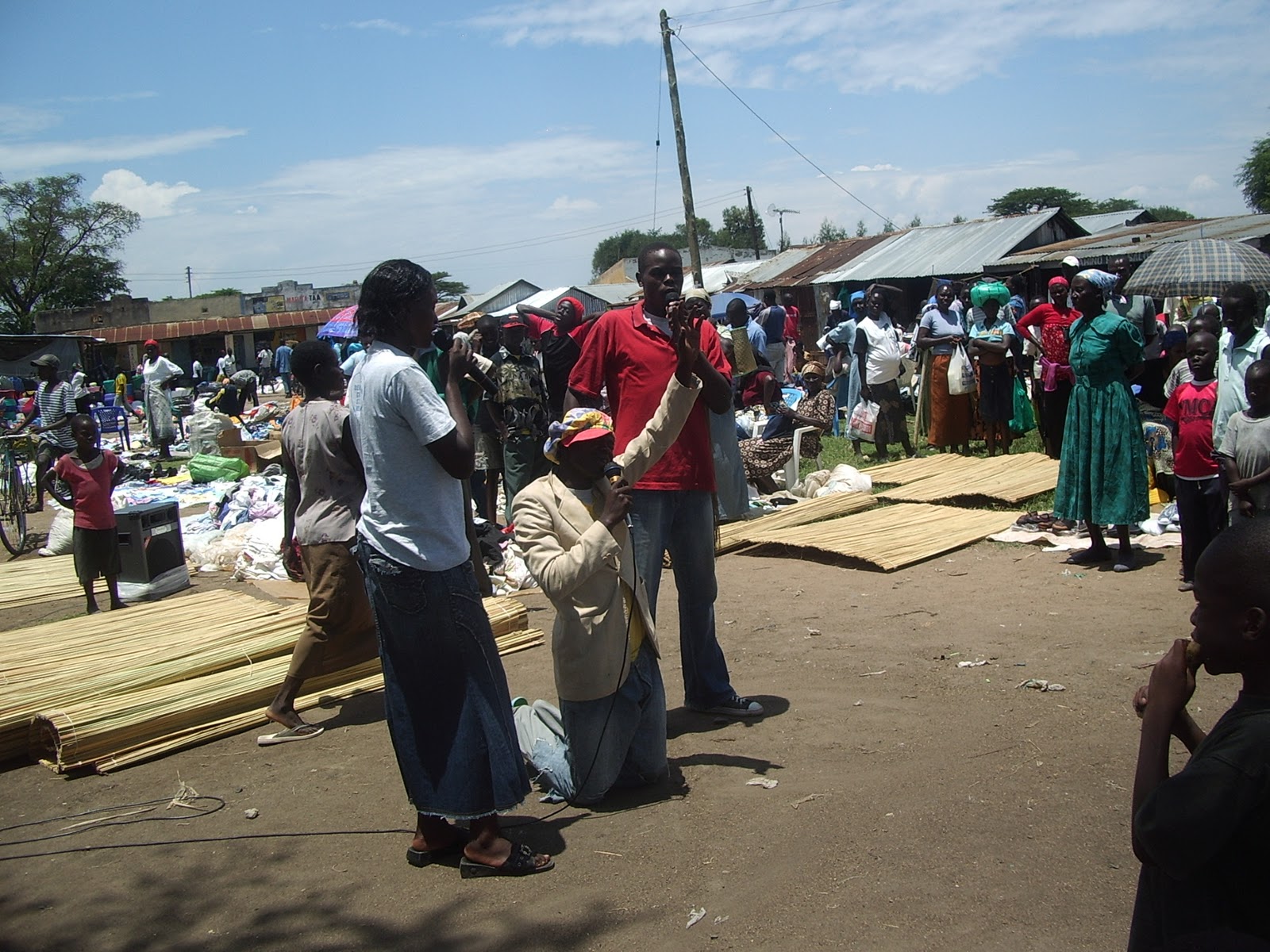 |
| Our actors having passionate discussion about VMMC. |
 |
| Our staff presenting a talk on sexual health and hygiene. We had a great audience at the marketplace! |
ACTS Website up and running!
Agape Counselling and Training Services (ACTS) now has an official website! Please find us at www.agapecots.webs.com to learn more in depth about all the programs we offer, and how to donate. We also have a PayPal, which makes donating to us free for you! Find us on Facebook and Twitter, and continue to read this blog, for real-time updates about ACTS.
15 November 2010
The ACTS Rabuor Voluntary Counselling and Testing (VCT) Center
Please read about our VCT Center in Rabour! We have another theater group event this Friday, 19 November, 2010, so keep your eyes open for more updates as we take our VCT center on the road!
The ACTS Rabuor Voluntary Counselling and Testing (VCT) Center
Our History
Due to the high prevalence of HIV and AIDS in Nyanza province, ACTS and the Center of Disease Control (CDC) jointly conceptualized the need for putting up a Voluntary Counselling and Testing (VCT) center in the Kisumu East District. Our center was constructed with the goal of reducing the spread of HIV and AIDS in the adjacent parts of Nyanza province. Thus, the Agape Rabuor VCT center, which is a stand-alone center situated in Kadibo Division, Kisumu East District, was set up and launched on 9 November, 2005 with the support of (CDC). It started offering full VCT services on 10 November, 2005. It offers full VCT services to eight locations and nineteen sub-locations with the population of about 100,000 people.
Activities
- General counselling
- Voluntary counselling and testing at the site
- Home Based testing and counselling
- Counselling and testing outreaches
- Public dialogue/theater group
- HIV/AIDS awareness
Achievements
Our most notable success realized thus far is the counselling and testing of clients through the services offered by the VCT center. We continue to achieve this success through community outreach with our ACTS Theater Group on Behavior Change Communication, door-to-door VCT visits, knowledgeable and professionally-trained staff, and an accessible VCT center.
Challenges
The major challenges we face stem from the technicalities of running the project without funds. Our current staff at the VCT site is comprised completely of volunteers. The VCT site catchments area is relatively large, and so there is need for mobile outreaches and home-based counselling and testing that can reach the rural areas. Funds are always needed to facilitate the continued operation of our programs, which are especially dependent on the following:
- Paying salaries
- Mobile VCT
- Running daily activities of the office
- Home-based counselling and testing
What We Have Learned
- Many people are willing to know their status, especially when there are VCT services available nearby
- Currently, there is a lot of inaccurate information about HIV/AIDS in rural areas, a problem which the existence of our VCT center helps combat
- The rate of HIV/AIDS infections in Kadibo is relatively high
- There is a serious need for a well structured home-based care program for HIV/AIDS
Staff Members at ACTS Rabour VCT Center
Agape Rabuor VCT has a staff of three counsellors:
1. James Otieno Ogolla
2. Dorcas Atieno Ondiege
3. Maureen Achieng Ochieng
Our counsellors are professionally trained and specialized in the area of HIV and AIDS.
James Otieno Ogolla
Professional Training
- Higher Diploma in Counselling Psychology
- Certificate in HIV and AIDS Care and Management.
- Certificate in Counselling Psychology
- Kenya Accounting Technician Certificate (KATC)
Other Training
- Couples HIV Counselling and Testing (CHCT)
- Home-based Counselling and Testing
- Counsellor Supervision
- Trainer of Trainees (TOT)
- Voluntary Counselling and Testing
Dorcas Atieno Ondiege
Professional Training
- Diploma in Counselling Psychology
- Certificate in Voluntary Counselling and Testing
- Certificate in HIV/AIDS Management Course
Other Training
- Home-based Counselling and Testing (HBTC)
- Couples HIV Counselling and Testing (CHCT)
Maureen Anyango Ochieng’
Professional Training
- Certificate in Secretarial Work
- Certificate in Psychological Counselling
- Certificate in VCT Counselling
- Certificate in HIV/AIDS Management
Other Training
- Couples HIV Counselling and Testing (CHCT)
- Home-based Testing and Counselling (HBTC)
- Men Who Have Sex with Men course (MSM)
Our Location
Kisumu East District, Kadibo Division
Kochieng East location, Kochieng sub-location
Contact Us
Agape Counselling and Training Services (ACTS)
PO Box 1606 – 40100 Kisumu, Kenya
+254 736 245853
agapecots@gmail.com
One of our very talented counsellors, James, performing an HIV/AIDS test and counselling session:

Our Rabour location:

01 November 2010
ACTS Theater Group on Behavior Change Communication at Nyamware—UNDP and Kenyan Fisheries Event—29 October, 2010
This past Friday, ACTS traveled with the Theater Group on Behavior Change Communication to Nyamware, to take part in the UNDP and Kenyan Department of Fisheries event where local citizens who had been victims of the 2007 post-election violence were being given fishing nets and accessories as an empowerment initiative. This event was very well attended, by townspeople and governmental officials alike.
Among those individuals attending the event were the area Member of Parliament, Honorable Fred Outa; the Nyanza Provincial Commissioner, Mr Francis Mutie; the representative of UNDP Africa region, Mr Aeneas Chuma; local administration; and other esteemed guests. Approximately 500 townspeople also came to fill the seats! We were happy to have such a large audience to listen to our message about VCT.
ACTS presented as a precursor to the main speakers and presentation of the fishing nets. Our plays illustrated scenarios in which HIV/AIDS awareness, voluntary medical male circumcision, and general behavior change in order to reduce the spread of STIs.
We also were able to set up our VCT tent at the site. We were lucky enough to have on hand two VCT counselors, Hilda Atieno and Ben Odhiambo, from the Ministry of Health to work with our staff and lend us support. Throughout the day, we had about 20 individuals come forward for testing, so we were glad for extra help!
We thank UNDP and the Kenyan Department of Fisheries for having us out to their event. We also want to thank the town of Nyamware Beach for being such gracious hosts and a very enthusiastic audience!
Please visit our website at http://agapecots.webs.com to learn more about our ACTS Theater Group and VCT.
26 October 2010
Friday, 15 October, 2010 -- ACTS Theater Group on Behavior Change Communication at Korowe Marketplace and Kobura Primary School
A week and a half ago, ACTS traveled to Korowe Marketplace and Kobura Primary School with the ACTS Theater group to present plays illustrating the need for behavior change with regards to HIV/AIDS transmission.
The plays presented situations of married couples, youth relationships, and other examples of areas in which knowledge and action regarding Voluntary Counselling and Testing (VCT) for HIV/AIDS is needed. The actors encouraged Voluntary Medical Male Circumcision (VMMC) as a way to reduce the spread of HIV/AIDS. They also talked about hygiene and the dangers of having multiple sexual partners. They concluded by advocating for VCT in order to take action with anti-retrovirals (ARVs) if one finds him/herself to be infected.
At Korowe Marketplace, ACTS set up a tent in which an individual could get free VCT and be personally and privately screened for HIV/AIDS. We had 11 individuals come forward for testing, including some townspeople at the marketplace and school children who stopped to watch the presentations on their way home to lunch.
After Korowe, ACTS traveled to Kobura Primary School, a short 5 minute drive away, to present a play to the children on their “prize-giving day.” The play was very well received by both the children and their attending parents. The actors did a great job not only making the audience laugh, but raising awareness of the dangers of having multiple sexual partners and unprotected intimacy. ACTS thanks the staff at Kobura Primary for making us feel so welcome!
See our pictures of our group at the marketplace:


See our pictures of our group at the marketplace:


Our actors did a great job at the school!


Subscribe to:
Posts (Atom)